Showing posts with label Erik Jones. Show all posts

Wednesday, February 15, 2012

What's next?

You've submitted your application to SAIS Bologna. (What a relief, you say.)

What are the next steps for non-U.S. applicants?

First, Amina is going through the dossiers to make sure they are complete. If something happens to be missing from yours, we will be in touch with you. If you do not hear from us, all is OK.

Second, we soon will be arranging interviews. (Remember, only non-U.S. candidates to SAIS Bologna are interviewed.) A few words on them:

Interviews are conducted by members of the Admissions Committee. The Committee is made up of SAIS Bologna faculty and staff. Each candidate is interviewed by one member of the Committee.

If you have applied, you will soon be receiving an email proposing a date, time and venue for the interview. We base the choice of venues on the candidates' preferences as expressed on the application.

Some of the interviews are done face-to-face but by no means all. There is no disadvantage to doing your interview over the phone or via Skype. We do not expect candidates to travel long distances to participate in an interview. And a candidate can make every bit as good an impression on the phone or via Skype as in person.

The interview is a chance for us to learn more about the candidate and vice versa. It is not knowledge-based -- that is, it is not a test of one's knowledge. It is an opportunity for the candidate to say why SAIS Bologna is the right match. It is also an opportunity for the applicant to ask questions about SAIS.

The best way to prepare for the interview is to understand why you want to go to SAIS Bologna, how it would benefit you and what unique characteristics you would bring to SAIS.

It's likely that at some point the conversation will turn towards a current event that is relevant to you. There is no way to prepare for this except to know in advance that there is no right or wrong in such discussions, just the opportunity to show that you can think on your feet and express a reasoned opinion.

Prof. Erik Jones
(If you come to Bologna, be sure to ask me about my interview at the college I ended up attending. Very memorable but not something I'll put in the Internet.)

One other way to prepare for the interview: Get a good night's sleep.

Finally, one of the most watched videos that we have posted since we launched this journal shows Prof. Erik Jones discussing what he expects during an interview. Here's a link to the post.

Nelson Graves


Tuesday, January 24, 2012

Beyond final exams, a glimpse of Spring

It's exam period at SAIS Bologna. You can tell by the look on students' faces. As they work their way through finals, there is something on the horizon: the Spring semester. Which for most of our students is their last semester in Bologna before transferring to Washington.

In the Spring, students will be able to choose from more than 30 courses, half of which are offered only in Bologna. Click here to view the course listing.

Some courses are similar from year to year. Prof. John Harper will offer his debating course, always well attended, again this year. Some readers may remember a previous post that highlighted segments of debate in his class last year.

Prof. Erik Jones will teach an advanced research seminar for SAIS Bologna and also for SAIS DC students, who will via video hookup.

Prof. Michael Plummer will return from a stint heading the Development Division of the Trade and Agriculture Directorate of the Organization of Economic Cooperation and Development (OECD) in Paris. Prof. Plummer will teach a course that always attracts a large number of students: Asian Economic Development.

Each year some things do change. There will be a new course in Global Energy, part of the Energy, Resources and Environment concentration, and another in International Financial Markets.

The Spring semester will feature new speakers and seminars under the auspices of the Bologna Institute for Policy Research (BIPR). More on that later this week. You can have a look at past speakers by viewing BIPR's webpage.

Amina Abdiuahab

Friday, January 13, 2012

FAQs: the weeks ahead for applicants to SAIS Bologna

February 1: Candidates who want to study at SAIS Bologna in the 2012-13 academic year and who do not have U.S. citizenship face that looming deadline to apply.

No wonder then that we are receiving many questions about our procedures and what happens after a dossier is submitted. To make things simple we've identified the most common questions, and we think all candidates will benefit from seeing our answers.

Before we dive into the FAQs, we'd like to remind you that on Monday, January 16 at noon Italian time (1100 GMT) we'll hold our final online information session before the application deadline. Please send us a note at admissions@jhubc.it if you'd like to participate in the session.

Q: I have gathered my application documents. Where should I send them?
A: If you are a non-U.S. citizen and you wish to spend your first year at SAIS Bologna, please send any hard copy material to:

Johns Hopkins SAIS Bologna Center 
via Belmeloro, 11
40126 Bologna
Italy 

U.S. citizens and permanent residents who have chosen BO/DC (U.S. citizen or permanent resident) as their campus choice should mail hard copy materials to the SAIS DC Admissions Office.

Q: I mailed my materials to the SAIS Bologna Admissions Office. When will you acknowledge receipt of my documents? 
A: We are starting to review the application packages. It's difficult for us to email each one of you to confirm your documents have arrived. You'll hear from us if parts of your application are missing.

Q: Am I required to convert my overall undergraduate grade into a GPA?
A: No. You are not expected to provide us with a grade point average of your undergraduate degree if you studied in a country that does not use GPAs. But we do ask that you provide a guide to your university's grading system. Sometimes such a guide is on the back of your transcript. If it is not, you can click on this link to select the country where you studied and a guide to your country's grading system.

Q: The grading system for the country I studied in isn't available on the website you have provided. 
A: In this case, please ask the Registrar's Office of your university to give a guide to their grading system.

Q: I feel the grading scale provided on the website is somewhat incorrect.
A: If you feel your grades aren't being translated properly, please ask your university's Registrar's Office to provide a more comprehensive guide.

Q: Could you give some tips on the statement of purpose?
A: Sure. Please take a look at this post we published some weeks ago. You'll find tips from current students on how they wrote their statement of aims.

Q: Could you give some tips on the analytical essay. 
A: No problem -- here's another post. You'll find some words of advice from a student and the essay she submitted in the past.

Q: Can I go over the word limit in the statement of aims or the analytical essay?
A: Part of the challenge is to convey your thoughts and views while adhering to the word limit. It's best that you stick to the 600-word guideline. If you exceed the limit, cut the essay back.

Q: Should I choose a concentration now? What happens if I change my mind? 
A: In the application form we ask you to indicate a concentration that you'd be interested in pursuing. We also ask you to indicate your second choice. These are not binding. You'll have a chance to change your mind and switch to a different concentration once you get here.

The only concentration that is capped is International Development (IDEV), and it has a separate selection process. Preference is given to students who come from developing countries or have lived or worked in a developing country.

If you are interested in IDEV, you should indicate it as your first concentration choice. It tends to be very popular, and students who indicate it as a second choice are generally not considered for it.

Q: When will I be interviewed?
A: Interviews will be held in February and March. We will announce dates and locations shortly after the deadline.

Q: How will I be interviewed?  
A: You'll be able to interview in person, on the phone or via Skype. There's no advantage or disadvantage in the format.

Q: How is the interview conducted?
A: Last year we published a post in which we asked Prof. Erik Jones to tell us what an applicant should expect of an interview. You can watch the video here.

Q: What happens after the interview?
A: Your dossier will be evaluted by the Admissions Committee. The Committee's decisions, including financial aid packages, will be communicated to candidates in early April.

If you feel there's something we left out, please post a comment or send us an email at admissions@jhubc.it. We'll be happy to address your questions.

Amina Abdiuahab

Thursday, December 1, 2011

"La Rivista": Another glimpse into SAIS Bologna


Here's another window on life at SAIS Bologna: La Rivista magazine.

The latest edition -- available online here -- is a special issue that explores the 150 years of Italian unity. If you're interested in learning more about Italy and what goes on at the Bologna Center, it's worth a look.

The four pieces on Italy's 150th anniversary as a nation-state include three by SAIS Bologna professors (Adrian Lyttelton, Vera Negri Zamagni, Gianfranco Pasquino) and a fourth by Federiga Bindi, who is a senior fellow at SAIS's Center for Transatlantic Relations.

Here is Lyttelton on Italy's ambivalence towards its own birthday: "Why is the existence of Italy as a nation-state more subject to criticism than it was at the time of the 50th or 100th anniversaries?"

(Remember the photo of Garibaldi that we featured in last week's quiz? It came from Lyttleton's article.)

Negri Zamagni explores Italy's economic history and concludes: "Italy is now at a crossroads. What is badly needed is a government that has the courage to launch new infrastructure projects, make critical changes in public administration, revitalize innovation and improve the labor market."

Of course the jury is out as to whether the new prime minister, Mario Monti, will be able to do as much.

Last May we published a post on Alumni Weekend that included a video with Prof. John Harper discussing his 30 years at SAIS Bologna. La Rivista prints an abridged version of that talk in which Harper said: "The Center is a bit like the legendary Shepheard's Hotel in Cairo. Someone said that if you sat in the lobby long enough you'd see all the famous people of the age."

Vera Negri Zamagni
Other articles include reflections by second-year SAIS student Lu Zhang, a feature on Bologna's cuisine by second-year student Elizabeth Hegedus-Berthold and an interview with Prof. Winrich Kühne, whom we featured in a recent Dewar's profile.

A list of books and other publications by faculty take up an entire page (page 23) and include new titles written by a half dozen professors teaching at SAIS Bologna this term: Harper, Pasquino, Erik Jones, Stefano Zamagni, Richard Pomfret and David Unger.

(Disclosure: Lyttleton, Harper, Pasquino and Pomfret all taught me when I was a student at SAIS Bologna three decades ago. Seems like yesterday.)

Nelson Graves

Thursday, November 3, 2011

Meeting our faculty: Prof. Jones

Erik Jones is professor of European Studies at SAIS Bologna. He is also the director of the new Bologna Institute for Policy Research (BIPR).

One of the most viewed posts in this blog's 10 months of existence is a video chat with Prof. Jones in which he discussed the interviews that we conduct with all applicants. You might enjoy watching it.

While you're at it, check out Prof. Jones's work on the eurobond proposal.

Your degrees?
AB, Princeton
MA and PhD, SAIS


What courses are you teaching?
West European Political Economies, Central and East European Political Economies, Risk in the International Political Economy, European Research Seminar

Where have you taught?
Central European University, University of Nottingham, SAIS Bologna Center

How long have you been teaching at SAIS Bologna?
Since February 2001 – in residence since September 2002

A link to a recent publication/oped/academic work by you?
See http://www.jhubc.it/facultypages/ejones for publications

Anything special about SAIS Bologna?
The community atmosphere. I don’t know any place that has as tightly knit a group of students and scholars as we do.

Anything special about Bologna?
The combination of young and old. You have about 100,000 university students living and studying in a place that has a 900 year old university.

Your favorite book?
If you want fiction, then I read a lot of junky sci-fi (Robert Heinlein) and fantasy (Robert Jordan). My reading age varies between 13 and 16. I read the Game of Thrones books in about a month. I am now working on a series by David Weber. If you want non-fiction, then I would probably go with Richard Bookstaber’s Demon of Our Own Design or Robert Schiller and George Akerloff’s Animal Spirits. But I also enjoy books on US foreign policy and am working my way (slowly) through the various Republican candidates.

Hobby?
I like to swim, either long-course or open water. Sometimes I get afraid of what else might be in the open water – particularly when I cannot see the bottom.

A quote?
Churchill was pretty good with the one-liners. Take your pick.


Nelson Graves

Wednesday, August 31, 2011

No ivory tower

SAIS Bologna is first and foremost an academic experience. But don't expect an ivory tower.

Erik Jones
Our faculty have their feet on the ground and are engaged in some of the world's most pressing issues. Students benefit from the mix of theory and practice, not least of all when they speak to potential employers who are looking for savvy, plugged-in graduates.

If you have a few minutes, read this newspaper column by Prof. Erik Jones. Many of our readers know already that Prof. Jones heads the European Studies department at SAIS Bologna. He is also in the throes of launching the Bologna Institute for Policy Research.

Yet his head is anywhere but in the clouds, as you'll see from the article. There is no more pressing issue in Europe right now than the future of the euro zone and of the European Union. The kind of issue that is tackled full on by Prof. Jones and students at SAIS Bologna.

If you have a few more moments, you might like to check out contributions by other SAIS Bologna professors to the understanding of global current events.

Nelson Graves

Wednesday, August 24, 2011

SAIS Bologna's new offspring: Bologna Institute for Policy Research

Who needs another think tank? Or another acronym?

Well, SAIS Bologna.

In fact the Bologna Institute for Policy Research is not a think tank. According to its director, Erik Jones, it is an organic extension of SAIS Bologna's mission and will help spread an understanding of the work that is done at the Bologna Center.

Prof. Erik Jones,
BIPR director
The Institute -- BIPR for short -- is the brainchild of SAIS Bologna Director Kenneth Keller. "The idea behind the Institute is to take what we do at the Bologna Center and do it a little bit better," Prof. Jones explains in the video below.

That means leveraging research done by SAIS Bologna faculty, both resident and adjunct professors, and making it more widely known.

"We want people to know what is going on in the Bologna Center," said Jones, who is professor of European Studies.

You'll see on our visit of the Institute that it's still in its infancy. Kathryn Knowles, who is helping get BIPR on its feet, takes us on a brief tour. The hope is that the Institute, housed near SAIS Bologna's main building, will begin to hit its stride by the start of the academic year in early October.

What's in it for SAIS Bologna students? The Institute will offer opportunities to learn from some of the world's leading experts. It will promote the name of SAIS Bologna beyond the confines of the Bologna Center. That cannot hurt students when they start looking for a job.

And for those seeking to earn a few euros while at SAIS Bologna, the Institute will offer part-time work.

This year's students have the good luck to observe BIPR spread its wings and to benefit from the opportunities it will make available.


If you are receiving this blog post through email, click here to see the video.

Nelson Graves

Tuesday, July 26, 2011

Math and Economics: Staying Ahead of Events

You don't have to look far to see why economics is important to understanding world events. Take the front page of any major newspaper.

The debate in Washington over the U.S. debt ceiling. The euro zone's struggles with Greece (and vice versa). The Arab spring. Investor's views of News Corp's value following revelations of phone hacking by journalists at one of its newspapers.

Guess who?
How could you begin to grasp the complexities of any of these titanic issues without examining the economic forces at work?

Perhaps less easy to understand is why it's important to understand mathematics in order to master economics.

Incoming students who have been taking the SAIS Online Math Tutorial this summer, with the help of seven DVDs covering 86 modules, may be asking themselves that question. As might prospective applicants.

I asked Prof. Erik Jones about this relationship between mathematics and economics. Here is what he told me:


"At SAIS we teach economics both for substantive reasons and for methodological reasons. We want students to understand how the economy works but we also want them to realize why we believe it works that way. The recent economic and financial crisis is a perfect illustration of the importance of this combination. Many people had simple rules of thumb to explain how liberalized capital markets should be more stable than tightly regulated markets; many fewer understood the importance of basic assumptions about human rationality that lay at the foundation of those rules of thumb. When those assumptions proved to be incorrect – as former Federal Reserve Chairman Alan Greenspan explained to the House of Representatives – the whole edifice of free market economics came crashing down.

Prof. Erik Jones
"The connection between  the assumptions that underpin economic thought and the rules of thumb that guide ‘conventional wisdom’ works through logic as expressed in mathematical models. Those students who do not understand mathematics will never be able to trace back the links between what they think they know about how the economy works and what they assume to be true about the world writ large. As a consequence, they will never be able to anticipate what will happen should their assumptions prove incorrect. They will be trapped in the crowd, doing whatever everyone else is doing and hoping for the best. Our goal by teaching mathematics for economics is to help students avoid that fate. We don’t intend to turn SAIS students into mathematicians, but we do intend to give them the understanding that they will require to stay ahead of events."

If you're tempted to wager that the connection between mathematics and economics is relatively recent, think twice. The use of math in economics dates back at least to the 17th century before hitting its stride in the 19th.

I'm sure at least one of our readers can tell us more about the symbiotic rapport between math and economics -- if not now, then in a few more months.

Anyone seen this before?
In the meantime, let's get back to brass tacks. Incoming students are strongly encouraged to take both the pre-calculus and calculus tests online this summer before starting their course work. It's the best way to make sure you will thrive at SAIS.

Anyone who comes up short -- it happens -- will have an opportunity to take math catchup classes, either in pre-term or after, and to take the exams again.

The obvious question is: Am I required to take the math tests and to pass them?

The answer is less obvious. Do yourself a favor. Study the material, pass the tests and tackle economics with the confidence and skills you will need to succeed.

Questions? Send them to admissions@jhubc.it.

Thursday, June 23, 2011

Interning in Bologna

Most SAIS Bologna students have flown the coop for the summer. Two have stayed.

Valeria Calderoni and Saurav Rana are helping Prof. Erik Jones launch a policy research institute, and getting paid to do so.

Valeria & Saurav taking a break
In a video in Tuesday's post, Prof. Jones called the research institute "probably the most important change to the functioning of the Bologna Center that we've had in our 56 years of existence." Sure sounds major.

To anyone who has worked on such an ambitious project from the outset, the range of responsibilities that Valeria and Saurav are shouldering will sound familiar: from moving furniture to analyzing a speech by the outgoing U.S. Defense secretary.

Most Bologna Center students work internships between their year in Italy and their second year in Washington. They work all over the world, as befits a graduate school of international studies. Some of our readers may recall earlier posts on internships and career services.

In the video below, Valeria and Saurav discuss their work.


Once you're through watching that video, if you have a few minutes and you want to know how some educators feel when students leave after graduation, have a peek at these images.

Nelson Graves

Tuesday, June 21, 2011

Getting to the core

Earlier this month we published a post with a question from the final exam in International Monetary Theory. It was an opportunity to expose incoming students to the kind of question they will be facing soon and also to the Economics requirements.

Today we turn to another set of obligations: the core requirements.

Before getting into the nitty gritty of the core requirements, a word on why. SAIS students come from very diverse academic backgrounds. This year in Bologna we had 34 nationalities, and for 2011-12, students from 45 different countries have enrolled.

To ensure that all SAIS graduates have acquired a common set of useful skills and knowledge, we require them to meet a set of requirements in Economics, languages, history and political science.

There are four core subjects:
  • American Foreign Policy Since World War II
  • Comparative National Systems
  • Evolution of the International System
  • Theories of International Relations
You can read about the core subjects here and here.

Here is chapter and verse with respect to the core requirements:

M.A. candidates must pass written examinations in two of four core areas (except students in European Studies, who take three European Studies comprehensive exams). Students are urged to pass one of these exams by the end of their first year and to pass both before beginning the second year. Students with an adequate background are encouraged to take the core examinations upon entry. During the year, students may prepare for a core examination by studying on their own, auditing or enrolling for credit in a core course. Core exams are graded with a letter grade. Only passing grades appear on the transcript. Students who fail a core exam twice are required to register for the corresponding core course for credit. After enrolling for credit, a student's result of any prior examination is eliminated from the transcript, and grading requirements for regular courses apply. Core exams are offered three times a year at the Bologna Center: first week in October and at the end of each semester. 

So you can satisfy the core requirements by taking core courses, passing core examinations without taking the course or a combination of the two.

As with Economics waiver exams, you can satisfy a course requirement by passing the exam but you will not receive credit towards the 16 courses that must be completed in order to receive the M.A. It does free you up to take other courses beside the basic Economics or core courses

Prof.Erik Jones
Note that these core requirements apply to candidates for the two-year Master of Arts in International Relations. The MAIA, MIPP and Bologna Diploma requirements are different.

All of that is so complicated that the questions on the core exam in Comparative National Systems may seem, well, comparatively simple. Here is a copy of the exam.

And here is a video of Prof. Erik Jones, who taught that course in Bologna this past Spring semester, discussing the core requirements and his course. He also explains why his office is full of boxes.


Nelson Graves

Friday, April 8, 2011

Weekly quiz

It has been four months, almost to the day, since we launched this blog. It has been fun for us. We hope it has been useful for our readers.

We realize there have been imperfections and we could have done a lot of things much better. ("The perfect is the enemy of the good." - Who said that?) With your help, we will try to be better in the future.

We do feel that it has opened up a line of communication with prospective applicants and, now, with admitted candidates. We realize that some readers will turn to other forms of entertainment as the admissions cycle winds down. Thank you for your loyal readership.

We intend to keep up the pace of daily posts until mid-May. Admitted candidates will have lots of questions until the May 16 deadline for matriculation. Then we will continue posting at a slightly less torrid pace until the summer holidays kick in, when we will taper off somewhat but not completely. Come September, when prospective candidates start scouting for academic opportunities, we'll offer more regular posts.

We'd like to expand the type of posts that we offer and to include more input from readers. We are thinking of polls and consumer-generated content. Your thoughts are welcome, either via the comment space or in an email.

Please remember that you can subscribe to this blog via email by filling out the box on the right-hand side of the page. RSS feeds are also available. SAIS is also present on Facebook and Twitter.

This map shows our blog's readership rankings by countries (I realize that some readers use servers in other countries, so the rankings do not necessarily reflect where the readers live):


View Readership rankings in a larger map


As I write, we have had 17,953 page views.

Now, for the quiz. To keep on the same theme:

Which of our 82 posts has attracted the greatest number of pageviews?


Hint: Some candidates considered the post useful during the final admissions push.

For some reason I am having difficulty publishing a comment at the end of our blog. So be it. Here is what I was trying to say:

I received this from Sophia at 7:02 pm last night: "my answer for Friday quiz is the following - post 'A chance to put your best foot forward' dated March 9, 2011."

Thank you, Góes and Sophia, for your answers. You’re on the right track but not quite there yet. It’s unusual for our readers to be stumped more than 12 hours after we publish the quiz. It’s also ironic that a question about which post has attracted the most attention from our readers would prove so difficult.

So here is a hint: the post in question features Room 216 and a lot of books.

I’ve practically given it away. This week’s prize: a free lunch at Giulio’s and a cappuccino.

Nelson

--------------------------------

I still cannot post a comment. So I will write here ...


Both Anonymous and Fracuo are correct. Well done. It was indeed "Seeing how you think" on February 21, starring Erik Jones, professor of European Studies. Clearly Prof. Jones's insights into interviews attracted attention. I'd love to offer two lunches, but I wouldn't be able to recognize Anonymous, whereas I know who Fracuo is. Thanks to all for playing.


Nelson Graves

Tuesday, March 15, 2011

Academics and practitioners

SAIS faculty and alumni are thinkers, movers and shakers in their fields. You've already seen the guide detailing the faculty's expertise.

Here is some recent activity:

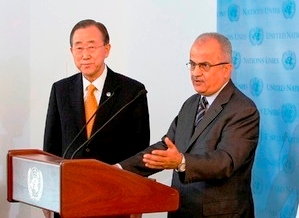
SAIS graduate Abdul Ilah Khatib, former foreign minister of Jordan, was recently named the UN special envoy for humanitarian affairs in Libya.

Abdul Ilah Khatib (r)
 with UN Secretary-General Ban Ki-moon
(UN photo)
Prof. Karim Mezran discussed Libya on Italy's leading national talk show Otto e Mezzo.

Prof. Erik Jones and Saskia van Genugten, both SAIS graduates, authored an editorial on Italy in de Volkskrant, in the Netherlands.

Prof. Michael Plummer was noted in Johns Hopkins Gazette for his coming role as a speaker at the Singapore Economic Review Conference to be held in August in Singapore.

Fouad Ajami
In the past two months, Prof. Fouad Ajami has published pieces in the Wall Street Journal, Newsweek, the New York Times and  Foreign Policy magazine.

Prof. Eliot Cohen published an editorial in the Wall Street Journal.

SAIS Foreign Policy Institute Fellow Josh Muravchik had pieces in both the Wall Street Journal and Bloomberg.

Prof. Michael Mandelbaum wrote an editorial for Project Syndicate.

For more information on our faculty, click here.

Nelson Graves

Monday, February 21, 2011

Seeing how you think

Today meet Erik Jones, resident professor of European Studies at SAIS Bologna. You can read more about his background, accomplishments and interests here.

Our subject today is not European Monetary Union or politics in Belgium, the Netherlands or Italy -- all areas about which Prof. Jones has written.

Rather, we have taken up some of Prof. Jones's time to discuss admissions interviews. We turned to him because he has considerable experience in interviewing candidates. Indeed he will be doing so in the next few weeks in Brussels and Vienna.

We wrote about interviews in a post earlier this month. We also touched on them last week. As you know, we interview all of our candidates, either in person, on the phone or via Skype. Each applicant will be hearing in the next few days about arrangements for the interview.

Erik confirms in his own remarks on camera that the SAIS Bologna interview is not so much a test of your knowledge as an opportunity for you to demonstrate your thinking power. Consider it a chance to put your best foot forward rather than a treacherous minefield.

Erik makes the point that the conversation can touch on current events. But for students of international relations, that should pose no problem, especially if the purpose is to hear you analyse events and trends shaping our world -- as you might like to shape it in the future.

Now, over to Prof. Jones.


Nelson Graves

Monday, January 24, 2011

Faculty: Embodying SAIS values

Like a human heart and its chambers, SAIS is powered by four main constituencies: students, faculty, alumni and staff. Without any of these, SAIS would not survive.

If the SAIS experience is special, it is in no small part because the faculty embody the values that underpin the institution: a global outlook, a desire to understand complex issues, tolerance of different points of view, appreciation of both academic and professional excellence.

Our relatively small size and the faculty's commitment to teaching allow students to develop strong relationships with their professors both in and outside of the classroom. The U.S.-style, discussion-driven classes put a premium on participation and interaction, and promote a cohesive intellectual community. Prof. Mahrukh Doctor touched on this in her post last week.

If you like being challenged intellectually, have an open mind but defend your beliefs, SAIS could well be for you.

Who are our faculty?

Kenneth Keller
First, SAIS Bologna. We have core resident faculty who ensure continuity and coordinate the integrated curriculum with SAIS DC. This year we have eight resident faculty including our director, Kenneth Keller. A chemical engineer by training, Prof. Keller is proof that many roads can lead to SAIS Bologna.

At SAIS Bologna there are five visiting professors and some three dozen adjunct faculty. The mix of resident, visiting and adjunct faculty promotes both coherence and diversity.

For more information on the SAIS Bologna faculty, you can click here. You can read biographies of Professors Harper, Cesa, Pye and Jones among other experts in their fields -- economics, international relations, development, finance, law, regional studies.

Expertise at your fingertips
Second, SAIS Washington. The dean is Jessica Einhorn, who has logged experience at the World Bank, the IMF, Time Warner and the German Marshall Fund. Let me not forget to note that she is also a professor of International Political Economy -- and a SAIS graduate.

If I dared to list the many internationally renowned faculty at SAIS, I would surely commit more than one error of omission. I don't contribute to this blog to make enemies.

But who would argue if I mentioned Professors Fouad Ajami, David Calleo, Eliot Cohen, Michael Mandelbaum and Riordan Roett?

There are others as you will see if you peruse the SAIS Guide to Experts in International Affairs. The specializations are too numerous to list here. Suffice it to say they cover all geographic areas and the hot-button issues of today -- and tomorrow.

Many candidates for admission ask us if they can speak to faculty. They may want to ask about a particular course or academic concentration, or to learn about what goes on in the classroom. They may be seeking advice.

Our faculty enjoy interacting with candidates, and we would be happy to put you in touch with the appropriate professor if you so wish. Just drop us a note.

Tomorrow: A video peek at SAIS Bologna

Nelson Graves

StatCounter