Wednesday, October 2, 2013

Academics: "A wild, inspiring, productive semester" for a new SAIS professor

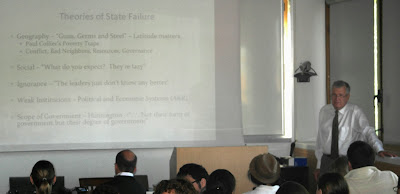
Prof. William Belding is teaching at SAIS for the first time this fall term. His course, "Weak and Failed States," attracted so many students that he will be offering two sections to accommodate all. Below Prof. Belding discusses his course and his background, including his service as a U.S. Navy SEAL during the Vietnam War and how that piqued his interest in studying state weakness.

Q: What course are you teaching?
Belding: "Weak and Failed States" -- two sections.

Q: What are the main themes? What are the readings, and what research will be conducted?
Belding: We will look at three issues: How are weak and failed states defined and measured; why have they failed, and what can be done to reverse failure, both internally and externally? A member of the faculty asked if we would be studying Italy and the United States. We will, at least when we take up the first of the three issues.
Prof. William Belding

The principal text is Acemoglu and Robinson's "Why Nations Fail," a recent work that has put this topic into the mainstream. Our research will be centered on case studies exploring the various faces and facets of weakness within regions, for example Zimbabwe and Botswana, Haiti and the Dominican Republic, Thailand and Cambodia.

Q: How would students find the course useful?
Belding: Though it is presented as a Conflict Management course, it is cross-listed in IDEV and has relevance to Strategic Studies. As both Robert Gates and Hillary Clinton have noted, in the decades ahead failed states pose the most lethal threats to security within developed nations. The humanitarian issues are also of great interest to many students and practitioners of international relations.

Q: How did you gain expertise in the field?
Belding: My interest began in 1967 when I went to Vietnam as a Navy SEAL. War creates an effective laboratory for studying state weakness, and the experiences I had over the next five years created a passion that has lasted my entire life. After a career practicing law but doing loads of pro bono work for NGOs in the humanitarian field, I was able to tap into this passion again by entering the international NGO world and working with war victims, primarily those injured by land mines. I worked in Cambodia, Vietnam and throughout sub-Saharan Africa.  Teaching is proving to be the culmination of all the work I have done over the years.

Q: How would you describe your experience at SAIS?
Belding: This is the first course I have taught at SAIS. It is different from Yale, The New School in New York and American University in Washington primarily because of its smaller enrollment and the international mix of the students, both of which make for a rich, enjoyable experience -- at least so far. And the staff is wonderful -- particularly the librarians and IT folks. I have never seen such dedication and competence. Most impressive, though, are the students. After just one class I know it is going to be a wild, inspiring, productive semester.
Q: Is being a Vietnam veteran relevant to your teaching?
Belding: The work we did in Vietnam was critical to my being drawn to teaching, as in a small, personal sense it provides an effective way to apply the lessons we learned in past conflicts to those looming on the horizon.

I could go on for hours on the broader topic of being a vet. Of great concern is the lack of understanding most citizens have of the role the military plays in their country -- not just the United States but the U.K., Italy, Australia and elsewhere. The effect of the volunteer army has greatly altered this matrix in the U.S. by reducing the number of soldiers, sailors and Marines and erecting a firewall between citizens and those who serve. Margel Highet (Edsdirector of Student Affairs) and I are hoping to bring veterans together with the SAIS community on Veterans Day in November. We will be lucky if we can find a dozen to attend.

Tuesday, October 1, 2013

Student Life: "A fantastic place for students"

From mathematical formulas to candidates' platforms for student elections: the writing is on the wall.

Two and a half weeks after SAIS Europe inaugurated a new study space, students are putting it through the paces.

I snuck into the new room today and saw students at desktop computers and laptops, some with cups of espresso nearby. Some had scribbled on the walls with the erasable ink pens provided by the Bologna Center.

"It's my living room," said Gena Kosmidou, as she settled into the second week of classes.

Said Rachel Finan: "The room provides a fantastic place for students to do group work, use the computers and relax between classes."

The new room, supported by the Class of 1981, is brainstorming central at SAIS Europe.

"It's a great space for students to learn from each other," commented Britt Johnson.

"The room is the perfect blend of a professional setting that has powerful technological tools, but it's also a space where people can gather for work or play", says Derek Schlickeisen.

Want to get a feel for the room? Here's a video peek.


Thursday, September 26, 2013

Applying to SAIS Europe: Standardized tests, bowls of porridge and more

Standardized tests: To take, or not to take.

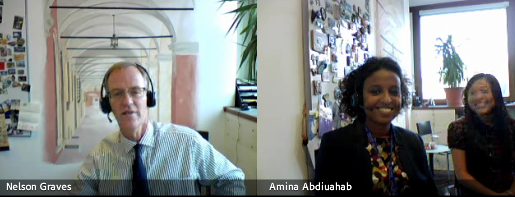
That was one of the questions tackled during an online information session that Amina, current student Jenny Lu and I tackled today.

We are interested in two categories of standardized tests: English-language competency tests for non-native speakers on the one hand, and the GRE and GMAT on the other.

ENGLISH

Non-native English speakers must submit the results of one of three competency exams as part of their application to SAIS. The three exams are the TOEFL, IELTS and the Cambridge Proficiency Exam.

For definitions of a native English speaker, you can review this document.
Nelson, Amina and Jenny during today's online information session
Note that if you are a non-native English speaker but have completed or are completing a full undergraduate program, taught in English, in a country where English is an official language, you do not have to submit the results of a competency test.

However, if your undergraduate institution is in a country where English is not an official language and you are a non-native speaker, you will have to submit the results of such a test.

GRE/GMAT

All U.S. citizens applying to SAIS need to submit the results of either the GRE or GMAT. All non-U.S. citizens who want to start their studies at SAIS DC or who are open to starting in either DC or Bologna need to take either of the two tests.

Non-U.S. citizens who want to start their studies in Bologna do not have to take either the GRE or GMAT. However, we strongly recommend that candidates take one or the other. Why?
  • A relatively strong score can help one's application;
  • The results can address questions about a candidate's English and/or quantitative skills;
  • A relatively weak score can send a warning signal to both the candidate and the Admissions Committee.
Do keep in mind that the results of the GRE or the GMAT will very rarely make or break an application; they are part of a complex dossier that the Admissions Committee reads very carefully.

Here is a slide that we showed at today's session that captures the middle 50% range of scores submitted by this year's SAIS students. These ranges do not include the top 25% or the bottom 25%, and so they reflect the middle tier:


Thus, of the incoming students who took the GRE, 50% scored between 157 and 165 on the Verbal section, and between 153 and 161 on the Quantitative section.

To a certain extent, therefore, these are the average scores.

Last year we published a post on the GRE and GMAT exams that you might like to look at.

Here are some of the questions that came up during today's session:

Q: Should I submit my GRE scores if I had a strong Quantitative score and a weak Verbal score?
A: Our advice would be to take the exam again and submit those scores. If you feel that your Verbal score continues to be weak, you can address this issue in your statement of purpose.

Q: What if I took few quantitative courses in my undergraduate studies? Should I take either the GRE or GMAT?
A: If your application does not give an indication of your ability to handle quantitative work, you would be best to take either the GRE or GMAT. The Admissions Committee wants to make sure that SAIS students can handle the challenging economics courses that are required of all.

Q: Will it help my application if I already have a master's degree from elsewhere?
A: The Admissions Committee is keenly interested in the applicant's academic background. A master's degree, especially if it is relevant to what is taught at SAIS, could strengthen the candidate's hand. However, the Committee is looking for a range of skills, qualifications and experiences, and each candidate brings a different mix.

Q: How long should the letters of recommendation be?
A: Long enough to present as persuasive a case as possible as to why the candidate should study at SAIS and what the candidate would bring that is unique to SAIS. Letters that are too short beg questions; letters that are too long can strain credulity. It's a bit like Goldilocks and the bowls of porridge: not too long, not too short, just right.

Q: Would you accept three letters?
A: We ask for two letters. We would prefer two strong letters of recommendation to three weaker letters.

Q: Can a recommender submit a letter in Spanish?
A: We ask that all letters be submitted in English.

Q: How can I organize a one-on-one chat with SAIS Europe Admissions?
A: You can send an email to admissions@jhubc.it, call +39 051 29 17 811 or send a message through Skype via jhubc.admissions.

Q: Will you be offering an information session on the analytical essay?
A: Yes. Below is the schedule of upcoming sessions. If you are interested in participating in any of them, please send an email to admissions@jhubc.it, and we will send you the instructions for connecting.

- October 23 at 4 pm CET (1400 GMT) - statement of purpose
- November 26 at 10 am CET (0900 GMT) - letters of recommendation
- December 12 at 4 pm CET (1500 GMT) - analytical essay

We recorded today's information session. If you would like to view it, please send an email to admissions@jhubc.it, and we will send you the link.

Nelson Graves

Wednesday, September 25, 2013

Academics: Meet Prof. Mahrukh Doctor

Prof. Mahrukh Doctor is an adjunct professor of International Relations and Latin American Studies who, like her faculty colleagues, helps set SAIS Europe apart. In addition to her work at the Bologna Center, she is a senior lecturer at the University of Hull and research associate at Oxford University and University College London. She has been a consultant at the World Bank. She brings academic and policy-making expertise to the Center, along with a global perspective that is a hallmark of the SAIS faculty.

Q: You last taught here in 2011-12. What have you been up to since?
Doctor: I have taught in Bologna every year since 2005. Unfortunately, last year I could not make it to Bologna due to scheduling problems. I went on exciting and interesting research/work-related trips to Australia and Mexico. I am also writing a book on business-state relations in Brazil, with special reference to the lobby for port modernisation.

Prof. Mahrukh Doctor
Q: What are you teaching this fall? Any changes in the course since you last taught it?
Doctor: I am teaching the "Survey of Modern Latin American Politics" course. It is an introduction to contemporary politics in the region. The syllabus covers a specific set of issues and countries, but each year I adjust the content and emphasis of lectures to address themes that might be particularly relevant at the time.

Q: How do you feel about returning to the SAIS Bologna Center? What in your mind distinguishes the program?
Doctor: Although I normally live in the UK and the commute to Bologna is about 8 hours each way, I am always delighted to teach here. The student body is diverse, lively and benefits from the presence of students from all around the world. The students are eager to learn and it is always fun to teach them. The programme is challenging, rigorous and also benefits from the variety of different academic traditions and approaches represented by the faculty, all congregated in a single place: the SAIS Europe/Bologna Center. I also look forward to joining my colleagues at the lunch table in the SAIS "bar".

Q: Can a student spend a year in Bologna and do the Latin America concentration? Wouldn’t it make more sense to do two years in DC?
Doctor: SAIS Europe presents a great opportunity for students with a concentration in Latin American Studies to spend their first year in Italy. The required range of course offerings are available, and they benefit from being taught by both European- and US-based faculty over the two years of their studies. Needless to say, this provides additional nuance to their understanding of the region. Moreover, Bologna-based students do not lose out on study trips or internship opportunities available to their DC classmates. Surely, it is the best of both worlds!

Tuesday, September 24, 2013

Student life: transitioning from Bologna to DC

Michael Aubry was a student at the Bologna Center last year and has just started his second year at SAIS DC. Here he tells us of his transition from Bologna to the U.S. capital, a shift that about one half of SAIS MA candidates make at the end of their first year of study.

Today marks the end of the third week of classes and the fourth week of my new life in the District of Columbia. We bolognesi were told how different our lives would be after our move across the Atlantic.

I can now vouch for that.

Reason: Washington is bigger. Time and space have been upended and this city reshaped as America’s Rome.

Michael Aubrey (L) with fellow Bologna Center graduates
Akhila Raman, Felix Amrhein & Brian Wenzler at SAIS DC
Urban agglomerations offer unique qualities and opportunities. This city moves fast. Transit tries to keep up – most of the time. The Washington Transit Authority may not be perfect, but it is practical in situations where cross-city transport is necessary. Many have elected to use DC’s quite successful Capital Bikeshare program to facilitate personal transportation. If you live near a bike station, Bikeshare is a helpful option. Tried and true walking, a mainstay of my Bologna life, is feasible but time-consuming.

Due to these considerations, social gatherings are less spontaneous. Advanced planning is a necessity, particularly since we are spread out across the various neighborhoods of Columbia Heights, Logan’s Circle, Shaw, NoMA and Dupont among a dozen others in DC, Maryland and Virginia.

Unfortunately, more people means more crime. I never felt unsafe in Bologna, and I don’t feel unsafe here. But being at the wrong place at the wrong time can ruin anyone’s day. Even though the best preparation does not guarantee immunity, vigilance is key. With this in mind, the SAIS shuttle is an awesome service. I am wholeheartedly taking advantage of the free transport from SAIS to (basically) my front door.

Washington offers some fantastic opportunities, including a plethora of internship possibilities. Hundreds of lectures, both organized by and independent of SAIS, are available here. I do miss Italian food greatly, but I am enjoying the culinary variety DC offers.

As we are transitioning to DC, DC is transitioning itself. Areas that were once considered no-man’s lands have been, are being or will be renewed. Washington is a vibrant, young and intrepid city. District folks are extremely motivated and eager to succeed. It is exciting to see DC develop. Integration between the bolognesi and our DC counterparts is a two way street, but it continues abreast, albeit slowly yet organically. Time will tell, but I am optimistic.

Michael Aubrey (BC13/DC14)

Thursday, September 19, 2013

Bologna:SAIS Europe's host city

We may have changed our name, but Bologna remains our home.

For the 59th time, a new class is discovering Bologna's charms and traditions. The name SAIS Europe captures the breadth of our scholarship and thought leadership. But the medieval capital of the Emilia-Romagna region remains our host city.

Six decades after the Bologna Center was founded, the choice of location might seem unusual to some. But to historian and founder C. Grove Haines, cognizant of Italy's historic role in shaping our world and of Bologna's long tradition of intellectual leadership, it made sense.

A decent guidebook will provide you the basics about Bologna: home to the world's oldest continuously operating university, largest city in Italy's Emilia-Romagna region, gastronomic capital, home to a Serie A football team and one of the country's most successful professional basketball squads.

It helps to be in the city to appreciate the homogeneity of its architecture, its bustling streets and markets, the green slopes of the Apennines on the southern outskirts of the city.

From time to time, we've posted videos and photos of Bologna. Below is a fresh video with glimpses of the city center, featuring a song by Gianni Morandi and Lucio Dalla, two well-known singers from Bologna.

Bologna Mayor Virginio Merola will deliver an annual welcome address to our students next week, a reminder of the Bologna Center's strong ties to its host city.


 Nelson Graves

Wednesday, September 18, 2013

Student Life: New student space to meet changing needs

Wanted: a name for a new space.

Last week SAIS Europe inaugurated its new "anti-library" -- a spanking new space where students can study in groups, brainstorm while sipping coffee and scribble equations on the walls.

The brainchild of last year's class, the room meets the changing demands of today's graduate students, who often work in groups, with a tablet in one hand and a bite to eat in the other.

Modular furniture and fast computers
It also underscores the sense of community at SAIS.

Students can still find hushed silence in SAIS Europe's library. The new space, shaped during weeks of pounding and painting this summer, replaces the former dimly lit student lounge with a brighter area featuring a 55-inch flat TV in one section and tables and chairs on wheels in the other.

SAIS students no longer have to jostle for space in Giulio's bar when studying in groups. They can merely take a new set of stairs up to the study space -- which so far has no name.

Suggestions for a name are welcome.

Announcing the treasure hunt winners
Last Friday's inauguration featured a treasure hunt organized by the pre-term Italian language teachers. Students who took Italian classes in pre-term were divided into groups, each named after an Italian cheese: the Mozzarelle, Provole, Caciotte, Pecorini, Gorgonzola and Taleggi.

The teams had to explore Bologna and engage with locals in Italian to find the hidden hints. The competition ended in the new space with each group singing a song they composed on the fly -- in Italian, certamente. The winners walked away with traditional Italian food products.

The room was created in response to a request by students for a space of their own where they can meet, discuss and brainstorm.

Write to your heart's content -- on the walls. It's erasable.
Students from the class of 2013 contributed ideas and helped design the space to meet students' needs.

The administration listened and then acted. Alumni from the class of 1981 made the project financially possible. Very special thanks to them for their effort, dedication and commitment to the Bologna Center.

The new study space takes the place of the old computer lab, which no longer suited today's needs. Now students who leave their laptops at home for the day can use eight desktops with high-definition streaming. Those with laptops, tablets or smartphones can tap into SAIS Europe's wireless network.

The summer renovation also produced a new classroom that is adjacent to the new study space, as well as a fresh language lab.

Amina Abdiuahab

StatCounter