Tuesday, April 30, 2013

Academics: Learning to excel

To help prepare students for the global job market, SAIS offers professional development skills courses that supplement the core academic curriculum. The courses range from practical negotiating to financial accounting. Below, Ann Dailey writes about a skills course that leveraged the expertise of her fellow SAIS Bologna students.

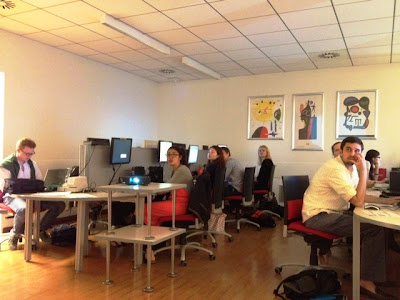
It’s a sunny Sunday afternoon in Bologna, and the computer lab is filled with students participating in a three-hour seminar to learn advanced Microsoft Excel skills.

All year long, the Career Services office has provided free Excel Skills courses, and more than 120 students have participated in one of the 10 courses (five Beginner, five Intermediate).

The Beginner course took students all of the way from finding cell A1 to sorting, graphing, and using logic and financial functions that would help them with their SAIS coursework.

After a quick review of the basics, the Intermediate course teaches more advanced logic and statistical functions as well as advanced formatting and graphing skills to help students prepare professional quality graphs and charts.

Career Services responded to students’ demand for more training by developing Excel Day. Rather than a structured course, Excel Day is a three-hour session where students work on career-focused Excel projects developed by fellow students.

Head Excel instructor Kayoko Lyons, who worked as a financial analyst for JPMorgan Chase, organized the day and helped four student instructors develop the projects.
The finance projects, developed by Brian Ku (who worked for KPMG) and Matt Conn (who worked for Luxor Capital Group) included capital structure, personal portfolio, XIRR and Collateralized Debt Obligation projects.

Ian Muir, who worked for PFC Energy, developed a project that exposed students to a range of exercises one would face in the world of energy and climate change consulting. Finally, Monica Wojcik, who worked for FTI Consulting, built a project that guided students through the creation of a trade profile for Chile by cleaning up and analyzing large datasets.

Max Cohen, who attended Excel Day, said "=if("Max learns a lot","awesome","a shame.")."

Ann Dailey (BC13/DC14)

Thursday, April 25, 2013

Academics: Filling your plate at SAIS Bologna

Imagine a Smörgåsbord table groaning with dozens of dishes. Between the appetizers, main dishes and deserts, you have room on your plate for eight.

Problem or opportunity?

Next year the tentative plan is to offer 77 courses at SAIS Bologna. Each student normally takes eight.

Of the courses on the menu, nearly half -- 35 -- are offered only in Bologna. That is one reason why students are strongly advised to look carefully at the curriculum to make sure they can take advantage of the unique offerings in both Bologna and DC while also keeping an eye on required courses, most of which are taught on both campuses.

Here is a tentative list of the courses offered next fall. To extend the analogy, there are some tried and tested staples: Theories of International Relations, Corporate Finance, Foundations of International Law, Survey of Modern Latin American Politics.

Many of the courses are unique to SAIS Bologna: Western European Political Economies; Science, Technology & International Affairs; The Twin Pillars of the Gulf, to name just a few.

And some are both unique to Bologna and brand new: Weak and Failed States, East Asian Security.

The same for the spring semester's curriculum. SAIS Bologna students can taste The Economies of Central Asia, Europe's Long Peace, Renewable Energy and Development Cooperation.

New next spring will be Constitutional Development & Democratization, Quantitative Methods in International Relations and Major Powers in the Middle East: Turkey.

As the SAIS brochure says: "Our curriculum -- emphasizing interdisciplinary breadth, a solid foundation in economics and deep knowledge of key world regions -- prepares students for a successful career in international relations. The result: innovative thinkers equipped with economic and cultural expertise as well as hands-on experience who are ready to confront complex global challenges."

That's true for all of SAIS -- Bologna, DC and Nanjing.

Buon appetito.


Wednesday, April 24, 2013

Student Life: Looking beyond the books


SAIS is fundamentally an academic experience. With final examinations on the horizon, it's no wonder coffee consumption and library usage are on the rise.

But SAIS is not only about academics. This blog has highlighted sports, clubs, guest lecturers and social events among ways students enhance their experience in Bologna.

You can add fund-raising to the list. At various points this year, large numbers of SAIS Bologna students have been involved in collecting donations for a wide variety of causes.

Nearly two dozen male students grew moustaches in the fall as part of the Movember movement to raise money for prostate cancer research. Students collected more than $1,000 with a trivia night and sports tournament and by selling calendars ("The Mustached Men of SAIS Bologna 2013").

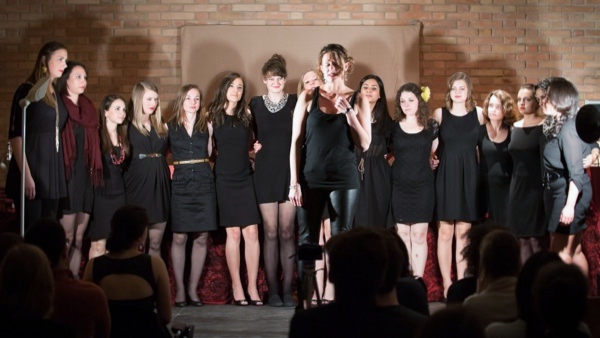
This month, 17 SAIS Bologna women took time out from their studies to put on a production of "The Vagina Monologues". The sell-out audience awarded the thespians with a standing ovation and more than $1,000 in donations toward the Casa delle Donne, a shelter for abused women in Bologna. A string of other events are being put on this month to raise money for charities combating sexual abuse.
17 actresses for a cause

This post is for those who have dedicated time this year to these and other such events. You are living proof that a year at SAIS Bologna is more transformational than I had dared imagine before coming here.

Felix Amrhein (BC13/DC14)
Photo by Ian Muir (BC13/DC14)

Tuesday, April 23, 2013

Life in Bologna: Unexpected colors

A cooler and wetter spring than usual has kept many SAIS Bologna students indoors. This year's class may be paying the price for a very dry year in northern Italy in 2012.

But there are upsides to damp weather. It can be easier to study. Bologna has a great many cafés and restaurants where one can take refuge. And the sky can yield unexpected colors such as those captured in a photo this week by current student Tristram Thomas:

Anyone interested in checking out the Bologna weather and skyline can always click on this link to see what the webcam on our penthouse terrace is seeing. Right now it's showing this:

Nelson Graves

Thursday, April 18, 2013

Student life: the SAIS kaleidoscope

There's hardly a better way to get a feel for student life than to read the student newspaper.

This month's student publication at SAIS -- The SAIS Observer -- captures the complexity of the experience.

There are contributions from SAIS's three campuses: Bologna, DC and Nanjing.

Here are some of the topics: agricultural policy studies, a debating course focusing on U.S. foreign policy, Taiwan-South Korean relations, teaching youth in Bologna and migrants in China, interviews with former Peace Corps volunteers, the Latin Dance Club, a new study area at SAIS Bologna, social entrepreneurship, a debate over democracy in China, the anxiety of career hunting and recipes for students on a stringent budget.

Two items have been covered in this journal: the Austrian ball and the Mr & Ms SAIS Bologna contest.

But try as we might, we can't cover the entire range of student experiences at SAIS spread over three campuses.

Nelson Graves

Wednesday, April 17, 2013

Careers: A learning experience in 'The Land of Fire'


Many SAIS students participate in study trips funded by academic concentrations. These trips, often to far-flung destinations, deepen students' understanding of key issues facing industries, institutions and policymakers in the relevant sectors and regions. Below, SAIS Bologna student Julia Heckmann writes about a recent trip she took to Azerbaijan with 13 other SAIS students.

Azerbaijan has both historical and contemporary significance in the upstream oil and gas sector. Its capital, Baku, is one of the birthplaces of the oil industry, and the recent development of the region’s offshore oil and gas fields and pipeline infrastructure has made Azerbaijan a focal point of the global energy market.

So I was very excited to participate in a recent five-day study trip to Baku. The trip was organized by a group of last year’s SAIS Bologna Center students who are concentrating in Energy, Resources and Environment (ERE), and it was funded by the ERE program.

Visiting SOCAR

The 14 of us explored Azerbaijan’s oil and gas sector and learned about the political challenges facing the industry by engaging with government institutions, industry representatives, diplomats, lobbyists and academics.

To get the most out of the trip and to prepare ourselves for our meetings, each student prepared background information on a specific topic or stakeholder ahead of the trip.

We started our week with a visit by to the headquarters of the State Oil Company of Azerbaijan (SOCAR). The meeting gave us insight into the history of oil exploration in Azerbaijan, the prospects for new projects as well as the strategy and drivers that govern the company’s decision-making process.

Other visits included a tour of the Sengachal Terminal where offshore oil and gas is processed and sent off via pipelines, and a meeting with the head investor of the State Oil Fund of Azerbaijan (SOFAZ).

What does that spell?
We met U.S. Ambassador Richard Morningstar at the U.S. embassy where we discussed geopolitical and diplomatic issues, including the ongoing conflict between Armenia and Azerbaijan over Nagrono-Kharabach.

Besides looking at Azerbaijan through the ERE lens, we took in Azerbaijan’s culture, cuisine and natural beauty by visiting ancient rock carvings and mud volcanoes at Gobustan National Park. The natural gas fires around the “Fire Mountain” Yanar Dağ made it clear why Azerbaijan is called “the land of fire”.

The trip was both great fun and a learning experience. After visiting the country in person, experiencing the culture, seeing production sites with my own eyes and talking to stakeholders, I have an understanding of the region that I would not have gained by simply studying a text book.

Julia Heckmann (BC13/DC14)

Tuesday, April 16, 2013

Open House: SAIS Bologna seen from the inside

Yesterday a number of admitted candidates participated in SAIS Bologna's annual Open House.

The day of information-sharing and encounters followed hard on the heels of SAIS DC's Open House last week, which was attended by candidates admitted to both the Bologna and Washington campuses.

These events provide visitors a chance to get to know students, faculty, staff and, crucially, fellow prospective classmates and to learn what makes SAIS tick. But we realize only a minority of the admitted candidates, who come from dozens of countries around the world, can attend.

Admitted candidates listening to Director Kenneth Keller and faculty

For the benefit of those who could not attend and, why not, for prospective applicants reading this journal, here are some of the key questions that were raised during yesterday's event in sunny Bologna.

Q: When are language proficiency exams offered?
A: Three times a year: at the beginning, middle and end.

Q: What kind of extra-curricular activities are offered at SAIS Bologna?
A: There are many clubs -- the Dance Club, the Defense and Intelligence Club, the Latin American Club, the China Club, the Poker club. The types of clubs that are formed depend on the students' interests. The Student Government Association (SGA) has a budget that helps defray some of the costs.

Q: Is aid available for non-U.S. students during their second year of study while at SAIS DC?
A: Yes. Students interested in receiving aid during their second year of study apply for aid towards the end of their first semester in Bologna. Students are advised to start their search for aid from foundations outside of SAIS as early as possible.

Q: How do students find housing in Bologna?
A: The SAIS Bologna consultant, Salvatore, shows apartments to students on a first come, first served basis. The greatest number of apartments are available before pre-term and then before the first semester starts. Some students decide not to use the Bologna Center's service and find their own places through agents or want ads that are posted in the Center or around the city.

Meeting current students
and faculty
Q: What did you wish you had known before coming but did not know?
Nameerah Hameed (SGA member): "I thought I would not be able to do anything outside of my studies but now realize I could have. I could have applied for an internship post at the Bologna Institute for Policy Research. You can do things outside of class here."

Anika Sellier (SGA member): "I wish I had reached out more to alumni. They are all so excited to hear from us. I did not really know that until I met them."

Q: Are trips organized by Career Services funded by SAIS Bologna?
A: The students generally pay for the trips. The number of students for each trip is limited to 20, and there is a selection process.

Q: Do most students work internships between the first and second years?
A: At least two thirds of the SAIS Bologna students from last year's class and possibly more worked internships last summer. They worked in many different sectors all over the world.

Q: Is a student required to do an internship to graduate?
A: It is not a degree requirement, but some concentrations do require internships.

Q: How quickly do SAIS students find jobs upon graduating?
A: Between 50% and 60% of SAIS students have lined up jobs by the time they graduate. Within six months after graduation, more than 90% have jobs. "The fact is, students do get jobs, but they need to be thinking about it while at SAIS," Meera Shankar, director of SAIS Bologna Career Services.

Nelson Graves
Photos by Marwa Abdou (BC13/DC14)

StatCounter